
Write a toy database
What you end up with: a key-value store that keeps your data after the process exits, handles
deletes without losing them, compacts its files in the background, and answers reads in microseconds —
plus benchmarks that compare it honestly against sled and redb.
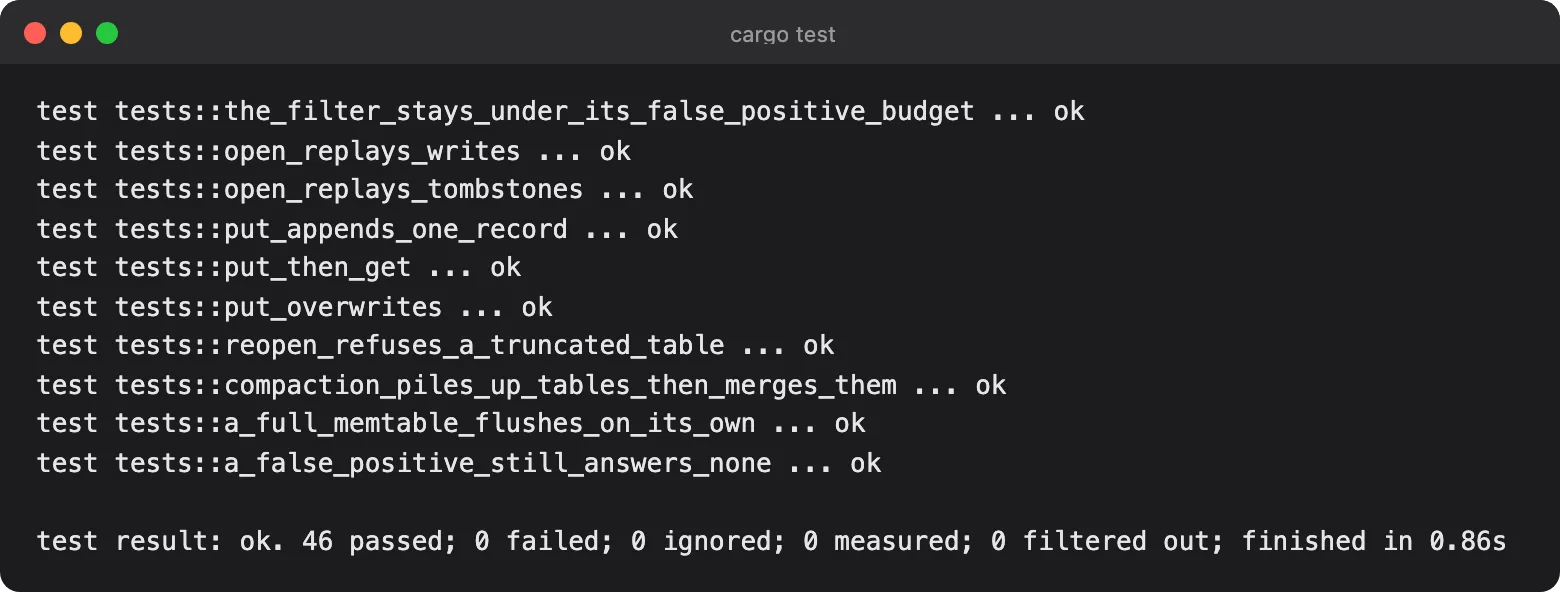
This is the track for people who want to understand how storage actually works. There is nothing
magical in a database: append bytes, keep an index, merge files occasionally. Writing one in Rust is
also the best exercise there is for Vec<u8>, &[u8], lifetimes and error handling in a codebase
that has to be correct.
What you’ll build
Section titled “What you’ll build”- Append-only data files with an fsync policy you chose deliberately
- An in-memory index (starting with
HashMap, ending with a real key format) - An SSTable format: sorted, immutable, with a sparse index
- Compaction that merges files without losing writes or deletes
- Bloom filters so missing keys do not touch the disk
- A write-ahead log and memtable
- Tombstones, range scans, and a snapshot-free iterator API
- Benchmarks against
sledandredb, including where you lose
Before you start
Section titled “Before you start”- Ownership and borrowing — this track moves bytes around constantly
- Smart pointers and memory —
Rc,Arcand interior mutability show up early - Modules, packages, and crates — the project outgrows one file by article 3
- Comfort with reading crash-safety reasoning: “what happens if the process dies here?”
Articles
Section titled “Articles”- What we’re building: a log-structured key-value storethe architecture, then one piece at a time
- A key-value store in memoryget, put, delete in a BTreeMap
- Appending writes to a logone line per write, and a checksum
- Replaying the log on startuprebuilding state, and skipping the torn tail
- Compacting the logrewriting so deletions actually free space
- Introducing SSTablessorted files with a sparse index
- Merging SSTablescompaction with tombstones
- A write-ahead log and a memtablethe pair that makes writes durable and fast
- Bloom filters to skip disk readsand the false-positive rate you chose
- Range scans and iteratorsimplementing Iterator over merged sources
- Benchmarking against sled and RocksDBhonest numbers, and where we lose
- What a real database does that we didn’ttransactions, MVCC, recovery
Where the code lives
Section titled “Where the code lives”toy-database/ in the examples repository —
one tag per article, plus the benchmark harness.